מזמור נ"ט עוסק באירוע של בריחת דוד מביתו בעזרת מיכל. אם נתבונן בספר שמואל (א י"ט) נראה דבר מעניין – לאורך כל הסיפור דוד לא פוצה פה ולא נוקט שום עמדה מעשית. ספר תהילים משלים את החסר ומגלה שמה שעשה דוד היה לומר תהילים. מדוע דוד לא נוקט שום עמדה מעשית כפי שהוא יודע? ולמה הובילה בסופו של דבר קבלת הדין ואמירת התהילים?

Just as the counting of the years leads towards the yovel, which clearly relates to the Revelation at Sinai, so does the parallel mitzva of sefirat ha-omer express our anticipation towards Matan Torah. But wherein lies the connection between Matan Torah and the jubilee year?

Through the symbol of doves, the individual demonstrates his yearning to return to the sacred, sublime environment of the Mikdash.

   The haftara for Parashat Metzora, taken from Sefer Melakhim II (chapter 7), tells the story of the siege mounted by the nation of Aram against the city of Shomron, capital of the Northern Kingdom of Israel.  The siege resulted in deadly starvation, to the point where mothers were killing their own children to eat their flesh (6:28-29).  The Israelite king (identified by Chazal as Yehoram, the son of Achav – Ta’anit 14b) blamed the prophet Elisha for the catastrophic conditions, and when he sent his guards to arrest Elisha, the prophet announced that already the next day

Rav Soloveitchik explained that a metzora, as opposed to an avel, is ostracized from the community.  Part of the definition of the metzora status is exclusion, as implied and reflected by the command of “badad yeisheiv.”  A mourner, however, is still included within the community, who, in fact, bears an obligation to embrace him and support him during his time of anguish.

Too often, when evaluating ourselves, we focus too much attention on the “healthy skin,” on the encouraging signs of improvement, so we can assign ourselves a status of “purity.”  The gratification we receive from positive signs of improvement must not lead us to conclude that we are “pure” and no longer need to grow and advance.  

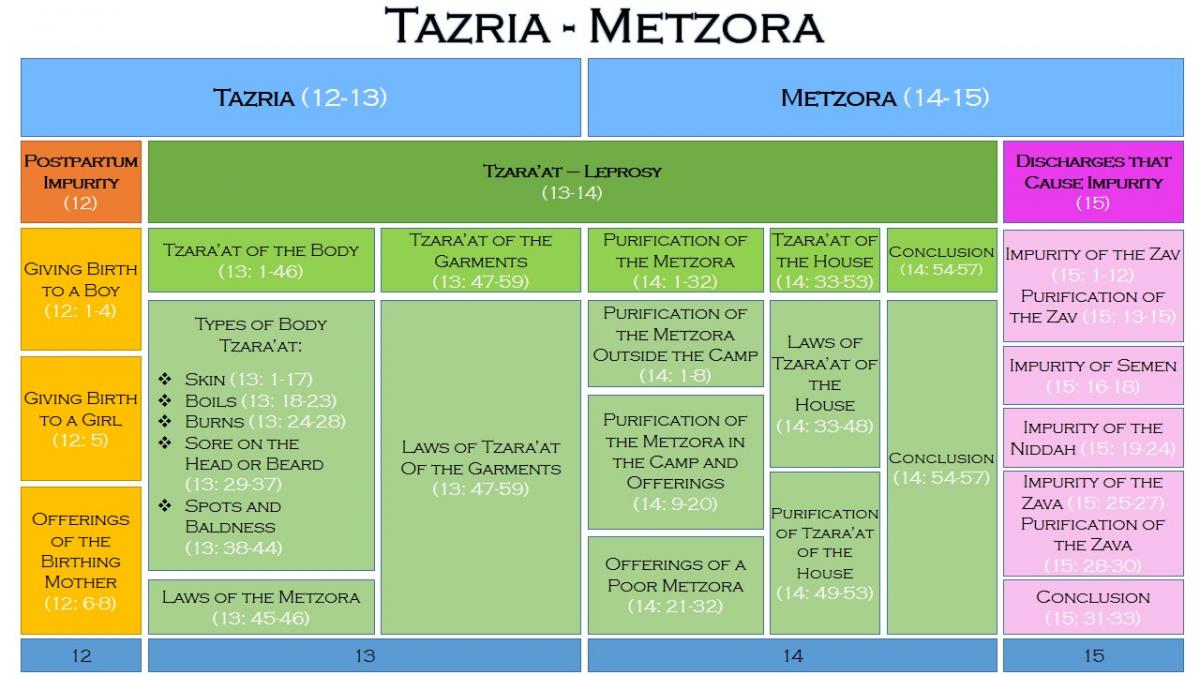
The process of becoming declared a metzora often involves a period  during which the individual must remain quarantined.  Now, as he regains his status of purity, he is being “set free” from this long period of seclusion, symbolized by the live bird being released from captivity. 

Adam” refers not merely to a human being, but to a great human being, a person of moral and spiritual achievement.   We achieve the level of “adam” not by ensuring to never contract tzara’at – spiritual illnesses – but rather by endeavoring to cure ourselves when this does happen.  

      The purification process required of a metzora, as we read in the beginning of Parashat Metzora, includes the slaughtering of a bird, and then dipping a second bird in the blood, after which the live bird is set free.  Rashi (14:4), citing the Gemara (Arakhin 16b), comments that this process includes birds as a symbol of lashon ha-ra – gossip and negative speech about others, the sin for which tzara’at is generally seen as a punishment.  The bird’s chirping symbolizes the

Pages

x