Moshe is one of the biblical figures whose life we follow from infancy to the time of his death. We learn of the vicissitudes of his fate and watch him as he grows and develops, until he finally becomes a leader. Among the Jewish people he is viewed as an exemplary figure who throughout history has evoked the curiosity of scholars, philosophers, artists and others.
It is difficult to examine Moshe’s personal nature in a short article, but we can focus on one element of his personality. One of the traits that Moshe describes at the beginning of his career as a leader is "I have never been a man of words ... I am slow of speech and slow of tongue" (Exodus 4:10).
God does not dispute this self-diagnosis, and it turns out that when God chooses Moshe it is a choice of someone who is not articulate, who finds it difficult to express himself, and is certainly not a demagogue. Moses may be charismatic, but language does not come easily to him and he does not engage the people by means of exciting linguistic formulations. Moshe is successful because the strength of his personality allows him to overcome his difficulty in speaking and expressing himself, to the extent that he is able to lead.
Rhetoric and its problems
Rhetoric is virtuosity. The foundation of this talent is the ability of a speaker to persuade people to choose values, make resolutions and decide between alternatives. Rhetoric is a tool in the service of reason, and it can offer detailed and convincing explanations for an idea. At the same time, it is a simply a tool, possessing no intrinsic content. A competent rhetorician can support one position and at the same time convince his listeners of the primacy of its complete opposite. In the early stages of history, rhetoric evolved as a truly artistic field. Different types of argumentative patterns emerged from it: poetic arguments, laden with superlatives and meticulousness that were built on structured formulations. Rhetoric was the focus of the cultural foundation in ancient Greece and constituted a basic tool needed by every citizen, to the extent that by the middle ages it was perceived as one of the basic studies essential for the education of every philosopher. These studies included the three elements of language: grammar, logic and rhetoric. Socrates, who opposed rhetoric, came out strongly against the lies and deceptions latent in this art. Socrates' famous statement posits that flattery of the body is cookery and cosmetics, and flattery of the soul is rhetoric. Rhetoric is, to a certain extent, a work of deceit.
Moshe was not one who practiced a twist of the tongue, nor was he blessed with a tone of certainty in his speech. There is no doubt that such talents are important for those who are destined for a public role of political leadership, which is why we can well understand his original complaint that he suffered from impeded speech.
Moshe's speech – An upheaval
With this background in mind, what comes in Parashat Devarim takes us entirely by surprise. Here we meet Moshe in his final days, presenting a lengthy speech to the nation that is carefully crafted, well-formulated, and includes a strong and forceful message. We are surprised, and the midrash is surprised, as well. We find it questioning how we can reconcile Moshe’s final speech with the personality that we have come to recognize in the previous three books of the Torah.
One of the midrashim explains this inconsistency as follows:
Until Moshe received the Torah, we find written about him “I have never been a man of words.” Once he merited and received the Torah, his tongue was healed and he began to speak. Where do we know this from? From what was said on this matter: “These are the words that Moses addressed” (Deuteronomy 1:1)
(Devarim Rabbah)
This midrash perceives an upheaval in Moshe’s personality or at least a change and development in his character. It also points to the cause – the Torah cured Moshe of his illness. We can explain the connection between the study of Torah and the healing of stuttering by suggesting that Torah and knowledge strengthen self-confidence. The more an individual relies on a broader knowledge base, the more he is confident about speaking; he is not afraid to express himself, and his advantage over others becomes clearer. These factors reinforce his personality with an inner strength that is expressed in the understanding that his words offer a contribution to the community; that he carries unique insights that come from the interrelationship between the Torah and the depths of his soul. For this reason, his stance is confident and his words become fluent.
Moshe's speech – An innate trait
An alternative explanation can be found in the Midrash de-bei Rabbi Tanhuma:
“These are the words.” Rabbi Tanhuma said: To what can this be compared?
To a man who was selling argaman – purple cloth – who was calling out ‘Argaman for sale!’
The king looked out and heard his voice.
He called to him and said: ‘What are you selling?’
He responded: ‘Nothing.’
The king said to him: ‘I heard you calling out that you are selling argaman, yet you say that you are selling nothing?’
He said to him: ‘Truly it is argaman. But compared to your possessions, it is nothing.’
(Devarim Rabbah 1:7)
According to this midrash, Moshe did indeed originally claim that he was slow of speech and slow of tongue, but this was not because he was missing the innate ability to argue, but precisely because he understood the full extent of his abilities in comparison to those of God. Before God, Who knows the hidden secrets of rhetoric and speeches, Moshe feels that he is bereft of the talent of speech. Even while that he was fully aware of his abilities, he did not dare to express them when he knew how limited he was in relation to the Infinite. Every speaker has an audience, every speaker knows that there are those in the audience who find his voice to be sweet.
This midrash can be understood in another manner, as well. It is clear from the outset that Moshe has precise logical abilities. In all of the conversations that God conducts with him, Moshe presents questions, breaking down the basic assumptions upon which God's request is based. Moshe's challenge is not a failure to understand and elucidate the questions, but to prepare a speech that can be delivered on a soap box, in order to present a clear and convincing argument to the people. What we find, however, is that it is not Moshe who needs to change, but the concept needs to be changed. There are those for whom words of truth are necessary, for whom beautiful words are insufficient. Those who need argaman will find soulful healing in that argaman. Even if the speaker is not blessed with a natural ability to speak, wisdom and life-experience can be perceived in his words, whose source is that of a higher power.
The two midrashim do not believe that Moses became a rhetorician and a demagogue, but both give an explanation for his ability to speak clearly and well at the end of his life. According to one midrash, it is personal, spiritual, intellectual development that create a platform for discourse; according to the other midrash, it is an innate ability of presenting the right thing in the right place.
According to both of the midrashim, Moshe did not become a populist or a virtuoso. He only taught his audience about what is hidden in a person's experience, what is concealed in silence and humility, and how powerful it is to listen.

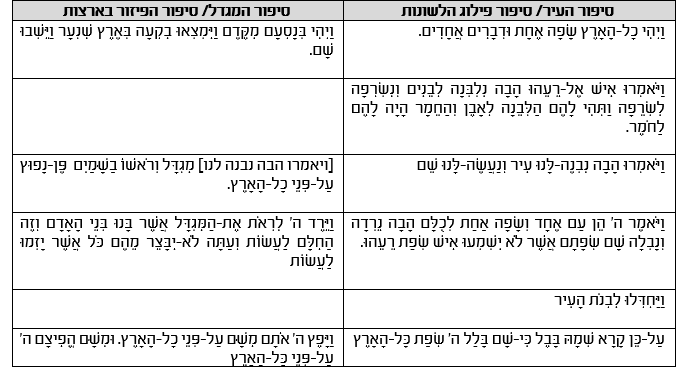 כפי שניתן לראות נראה שיש כאן שני סיפורים: הסיפור הראשון הוא סיפור העיר ואילו הסיפור השני הוא סיפור המגדל. שני הסיפורים מתרכזים בשני עניינים שונים: פילוג הלשונות מול פיזור הארצות. לא ניתן להיכנס למשמעות כפילות הסיפור, אך נראה שיש כאן שני חטאים, ושני עונשים שונים.