
Behar: Leaving Egypt

“I am the Lord your G-d, who took you out of the land of Egypt”.

While we associate these words with the first of the aseret hadibrot (ten commandments), the words above are actually taken from this week' s parsha. “If your brother becomes impoverished...do not take from him interest…I am the Lord your G-d, who took you out of the land of Egypt to give you the land of Canaan, to be your G-d ” (25:38). Rashi, quoting our Sages, suggests that the juxtaposition of the Exodus to the laws of interest teaches us that G-d took us out of Egypt for us to observe His commandments, even if it is difficult. In other words, G-d took us out of Egypt so that we could lend money interest-free!

This exact phrase, “I am the Lord your G-d, who took you out of the land of Egypt”, is also used in connection with the command to have “honest scales, honest weights, honest measures" (Vayikra 19:36). And Rashi, echoing what he wrote above, notes al menat ken, that having honest weights is the reason we were taken out of Egypt. Pesach, matzah, and maror play a secondary role in the Exodus to that of honesty and interest-free loans.

Yet, in discussing interest-free loans, the Torah adds an additional phrase not found in relationship to honest weights. “I am the Lord your G-d, who took you out of the land of Egypt to give to you the land of Canaan, to be for you a G-d". Rashi notes that by observing the Divine command, i.e., by lending money interest-free, we will merit to inherit the land of Israel.

Lending out money interest-free is difficult indeed. We charge others to rent our homes, cars or offices: we charge for all services, but somehow, when it comes to money, we must be there to help with no potential for profit; “ I am the Lord your G-d, who took you out of the land of Egypt”. In many ways, refraining from charging interest is an even more difficult command than that of the observance of shmittah, which forms a major part of the parsha.  

The Torah commands that all loans which are not repaid by the shmittah (sabbatical) year are to be cancelled, with the creditor losing not only any potential interest, but his principal. Yet the loss of principal is a risk that can be mitigated. One can do due diligence to ensure that loans are given only to those who are reputable, creditworthy and not likely to renege. And if one has miscalculated, well, that is the risk of business. But to let others use your money with absolutely no possibility of profit is most difficult indeed. Yet it is a necessary component of building up a nation. “Zion shall be redeemed through justice, and its returnees through charity". And there is no greater form of charity than lending money interest-free.

To be worthy of leaving Egypt, we need only ensure that our dealings are conducted honestly. However, in order to build a community in Israel, we must observe a more difficult mitzvah, the mitzvah of lending money interest-free.  

It was at Sinai that we heard the voice of G-d, who took us out of the land of Egypt. It was the Exodus that serves as the backdrop to revelation, and it is revelation that obligates us in mitzvoth. And immediately following revelation, the Torah lists much of our civil and criminal codes, identifying in great detail those mitzvoth that must infuse our daily (even, at times, mundane) existence. These laws begin by detailing the dignity with which a slave must be treated—a concept that was no less revolutionary than the notion of a G-d who intervenes in the historical process by taking us out of Egypt. “I am the Lord your G-d” obligates us to treat the weakest in society with the utmost of caring.  

Thus, we should not be surprised that immediately after the command to lend money interest-free, the Torah warns, “If your brother becomes impoverished with you and is sold to you [in slavery], you shall not work him with slave labour.” (25:39). Our Rabbis explain that slave labour is work designed to show the lowly status of one's employee, to create feelings of inferiority amongst the workers.

Offering employment to others is the one form of charity that “ranks” higher than that of an interest-free loan. Helping other Jews become self-sufficient is the road to redemption. But employment also affords the possibility to lord it over others, to raise ourselves as we lower others, to act like Pharaoh in Egypt. Let us remember that “they are My servants whom I have taken out of the land of Egypt” (25:42).

Courtesy of Torah in Motion - www.torahinmotion.org
Volver al capítulo

לחיות בשני העולמות

"אָגוּרָה בְאָהָלְךָ עוֹלָמִים אֶחֱסֶה בְסֵתֶר כְּנָפֶיךָ סֶּלָה" (תהילים ס"א, ה)


תלמוד בבלי מסכת יבמות דף צו עמוד ב - צז עמוד א 

אמר רב יהודה אמר רב:

מאי דכתיב [=מהו שכתוב] "אגורה באהלך עולמים" (תהילים ס"א, ה)?

וכי אפשר לו לאדם לגור בשני עולמים?

אלא אמר דוד לפני הקדוש ברוך הוא:

רבונו של עולם, יהי רצון שיאמרו דבר שמועה מפי בעולם הזה. 

דאמר רבי יוחנן משום רבי שמעון בן יוחי:

כל תלמיד חכם שאומרים דבר שמועה מפיו בעולם הזה, שפתותיו דובבות בקבר


Volver al capítulo

מה בין המזמורים?


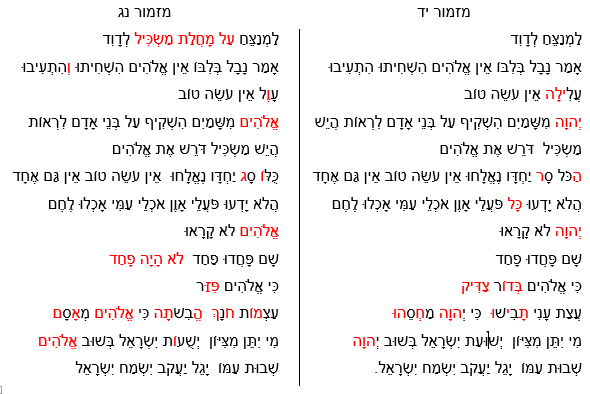
השוואת שני המזמורים מגלה שהשינוי המרכזי הוא לקראת סוף המזמור:


מזמור נ"ג מתאר אירוע שקרה: "כי א-להים פזר עצמות חנך הבשתה כי א-להים מאסם" (ו). לא לגמרי ברור על איזה אירוע מדובר. זאב ויסמן בפירוש 'עולם התנ"ך' מבין שהאירוע המדובר הוא אולי עם גוון לאומי וכך ה"נבל" שמדובר עליו במזמור נ"ג הוא אויב העם (כך מסביר גם רד"ק). בחינה של המזמור עצמו לא בהכרח מובילה למסקנה שלפנינו מזמור לאומי. אין אזכור של עם ישראל (מלבד "אכלי עמי" אך ביטוי זה מופיע גם במזמור י"ד, ששם אין סיבה לומר שמדובר במזמור לאומי), ואויב של ממש לא נזכר. 

ונחתום בדברי עמוס חכם שמסכם את הדיון ביחס בין שני המזמורים: "לא נוכל לעמוד על כל שינוי ושינוי ועל אחת כמה וכמה שלא נוכל למצוא שיטה אחת בכל השינויים".


לעיון נוסף בנושא ההבדל שבין המזמורים ניתן לשמוע את שיעורו של הרב יעקב מדן וכן את שיעורו של ד"ר בני גזונדהייט

Volver al capítulo

ישועתנו - ישועתך

"לְמַעַן יֵחָלְצוּן יְדִידֶיךָ הוֹשִׁיעָה יְמִינְךָ ועננו [וַעֲנֵנִי]" (תהילים ס', ז)


מדרש תנחומא (בובר) פרשת אחרי מות סימן יח 

אמר ר' אבהו: כל ישועה שבאה לישראל היא של הקדוש ברוך הוא, שנאמר "עמו אנכי בצרה..." (תהלים צ"א, טו). רבונו של עולם, הואיל ואמרת "עמו אנכי בצרה", כביכול הוא נושע, "הושיעה ימינך וענני" (תהלים ס', ז), שאם אתה עונה אותנו הישועה שלך היא, שנאמר "ולכה לישועתה לנו" (תהלים פ', ג). 


מדרש תנחומא - מדרש אגדה על חמשה חומשי תורה. המדרש החל להתגבש בארץ ישראל במאה החמישית אולם המשיך ונערך עד סוף המאה השביעית. המדרש בנוי מחטיבות של דרשות העוסקות בפסוקים הראשונים של כל סדר מקראי. (מתוך: ע' רייזל, מבוא למדרשים, מכללת הרצוג תשע"א)

Volver al capítulo

Behar-Bechukotai: End of the Story

"These are the commandments that G-d has commanded Moshe to the children of Israel on Mount Sinai (Vayikra 27:34)." Though it is the Book of Exodus that we associate with Har Sinai, it is at the end of Vayikra that the Torah actually places us there.

"Joseph died at 110 years; they embalmed him, and he was placed in an aron (casket) in Egypt." So concludes Sefer Breisheet. Joseph, who saved so many lives, is dead; and it would be many years before the Jewish people would escape from Egypt. The word "Mitzraim" comes from the root "tzar," narrow; the grand vision of Joseph is to be replaced by the narrow confines (physically and spiritually) of the life of a slave.  And if we go back to the very beginning, the "very good" of creation--the abundance of life--will soon seem like a distant memory as things will soon be very bad, with life replaced with death in the Nile.

As Sefer Shemot progresses, we move from the depths of despair to the heights of Sinai, from slavery to freedom, darkness to light. Instead of building cities for Pharaoh, we are busy building a tabernacle to G-d; and instead of working seven days a week, we are to rest on the seventh day.

"The cloud of G-d is upon the tabernacle by day, and fire will be there by night, before the eyes of all the Jewish people in all their journeys". So concludes Sefer Shemot.

The Jewish people are still on a journey. Receiving the Torah and building a tabernacle are not enough. It is in the book of Vayikra that we put the Torah into practice--in the reverse order to Sefer Shemot. We begin with the laws of how to use the tabernacle, how korbanot can help us get close to G-d. As we move towards the end of the book, it is the laws of social justice that take center stage--laws such as not treating our workers like slaves. The link joining these two spheres, the laws between man and G-d and man and man, is the call to holiness. Only with the implantation of "the majority of the essence of Torah" (see Rashi to 19:2) can we be said to be at Har Sinai.

Going through the birth pangs of the creation of a nation, Sinai, a mishkan, and even attaining holiness is still not enough. We must maintain that holiness--a most difficult task. Sefer Bamidbar examines the many instances when we did not.  If not us, it would have to be the next generation that would learn from the mistakes of the past. As the book ends, we find a expression similar to the end of Vayikra: "These are the commandments and the laws that G-d has commanded by the hands of Moshe to the children of Israel, on the plains of Moav by the Jordan river, by Jericho." We can see the goal, but we are not quite there.

Moshe spends almost the entire Sefer Devarim exhorting us not to repeat the mistakes of the past. Despite the fact that "no prophet has arisen in Israel like Moshe" (Devarim 34:10), it is time for a new leader to guide us to our destination. We should not be surprised to discover that the last word of the Torah is the word Yisrael. While the other four books of the Chumash end with the description of a physical location, Sefer Devarim ends with a description of the people of Israel. But if the people of Israel learn the lessons of the Torah, the people of Israel and the destination of Israel will be one and the same.  

 
Courtesy of Torah in Motion - www.torahinmotion.org
 
Volver al capítulo

Emor: The Joys of a Kohen

Being a kohen today is not what it used to be. While one may receive more aliyot and lead birchat hamazon on a regular basis, a kohen is bound by the many restrictions of the Torah without "reaping its benefits". There are strict and--in today's world of religious fluidity--at times, tragic restrictions on whom they may marry and whom they may bury. This, despite the fact that there is no Temple for them to work in, no sacrifices to bring, no regal clothes to wear, and no special food to eat.

kohen who was a ba'al mum, who had some kind of blemish disqualifying him from work in the Beit Hamikdash, nonetheless had to observe all the restrictions incumbent on the kohen. Apparently, the prohibition of coming in contact with death, of tumah, is unconnected to the Temple. Rather, it stems from a more fundamental role of the kohen, that of teachers of Torah. "For the lips of the kohen should safeguard knowledge and [people] should seek Torah from his mouth, for he is like an angel of the God of Hosts" (Malachi 2:7).

Our Torah is a Torat chayim, a book of life, focusing on the here and now of this world. The Torah tells us nothing about the afterlife or even the Messianic Era. Our task is to ensure that the world we inhabit today is a little bit better because of us. We focus on helping those in need, not in justifying G-d's allowance of suffering in the world. We focus on the living; thus, death and Torah are incompatible.

The kohen as the teacher of Torah must avoid contact with death. His headquarters are the Temple grounds, the place where the divine presence is most manifest. Death is tragic, defiling, and distances us from G-d. Death robs us of the opportunity to observe mitzvoth meant for this world; it robs us of a chance to gain further immortality. A mourner may not study Torah, the eternal book of life. With death, a piece of Torah has been lost forever. Furthermore, a person created in the image of G-d is no longer, and thus, kvayachol, a part of G-d has been lost.

Yet death is inevitable, and even the kohen must mourn for his immediate family and leave the confines of the Temple. Only the kohen gadol (the high priest) about whom we are told (figuratively), "and from the Temple he shall not leave" (21:13), may not defile himself even for an immediate family member. He represents the nation. It is he who attempts to atone for the sins of the entire nation on Yom Kippur.

And while all individuals die, the Jewish nation is indestructible. "The eternity of the Jewish people will not be denied" (1 Shmuel 15:29). The Jewish people are not susceptible to the impurity of death.

After describing the laws relating to the kohanim, the Torah details the laws relating to the five biblical holidays. The yamim tovim signify the eternity of the Jewish people, our defiance of the natural laws of history, and of the special relationship between G-d and the Jewish people. We have survived will continue to prosper and will not cease to inspire until all hear the message of a moral G-d.

"And you shall be for Me a kingdom of priests and a holy nation". While only biological kohanim could work in the Temple, all of us, with or without a Temple, must adopt the role of kohanim. We must strive to teach Torah, serve others, and--following in the footsteps of Aharon, the first kohen gadol--we must "love peace and seek peace."

Courtesy of Torah in Motion - www.torahinmotion.org

Volver al capítulo

Shemini: Close to G-d

The deaths of Nadav and Avihu have long troubled biblical commentaries. The multiple suggestions put forth demonstrate that—objectively speaking—whatever the true nature of their sin may have been, it does not seem to have warranted the death penalty. Under different circumstances, or had others done what they did, they likely would have been spared. But not Nadav and Avihu.

Sefer Vayikra opens with the bringing of voluntary sacrifices, an olah (burnt offering), mincha (flour offering, and shelamim (peace offering). While there are times when these sacrifices are mandated as described in later chapters of the Torah, it is the voluntary act of bringing a gift to G-d, of sharing with others (as was done with sacrifices), that is most noble. It is only in chapter four that we first hear of the obligatory korban, the chatat (sin) offering, and even then, it is for “a person who inadvertently sins”.

This notion of voluntary offerings to G-d is one that permeates the building of the mishkan. The Torah, in describing the contributions of the Jewish people toward the mishkan, often uses the expression “nediv libo”, a gift from the heart. The mishkan was build from the trumot, the voluntary gifts, of the Jews. The willingness to volunteer was so great that that Moshe had to tell them to stop, as their gifts were no longer required (Shemot 36:6).

What could be more natural and praiseworthy upon the dedication of that mishkan than bringing a sacrifice, specifically one “they were not commanded”? And in truth, Moshe—in the immediate aftermath of their deaths—implies that objectively speaking, what they did was most worthy: “This is what G-d meant when He declared, ‘With those closest to Me, I shall be sanctified'”. So that just begs the question: Why did they have to die?

“For My thoughts are not your thoughts, and My ways are not yours” (Isaiah 55:8). The ways of G-d are hidden from us, and the only possible response is that of Aaron, the grieving father: “and Aaron was silent.” Any attempt to explain the unexplainable is unlikely to bring comfort, and runs the risk of making matters worse.

It is most appropriate that we read parshat Shimini, as we often do, during the week of Yom Hashoah when not only the sons of Aaron, but all of Israel was consumed by fire. Some managed to survive the fire, but all were burnt. And while we must speak of the horrors—for ourselves, for our children and grandchildren and for the world at large—we are silent in trying to offer explanations. To ascribe reasons or justifications for such horror to innocents would border on the blasphemous.

The Torah follows the deaths of Nadav and Avihu with the laws of kashrut. This is no coincidence. The Torah equates kashrut with kedusha, holiness. One can achieve holiness through spiritual pursuits, through cleaving to G-d, and one can attain holiness through elevating of our physical beings. And for many, the latter approach is the better one.

Being in the constant presence of G-d and working in the Temple offers much potential for growth, but also great danger. Coming close to G-d without being fully prepared can be deadly.

In Rabbinic literature, this is best exemplified by the story of the four Sages who entered Pardes, seeking to understand the mystery of the Divine. Of the four, only Rabbi Aviva emerged unscathed, as he alone “nichnas beshalom, entered in peace.” We might say that he entered complete, or prepared.

The effects of this sudden rush to spiritual heights helps to explain the frequent phenomenon in which many of those who become (more) observant “overnight” soon revert back to their old ways, alienating themselves even further from the religious framework than previously.

For most holiness is best achieved in our day-to-day activities, where G-d's impact is felt in the most natural of ways, almost subconsciously. Maimonides, in his Sefer Kedusha (The Book of Holiness), includes only three sections: the laws of forbidden sexual relations, the laws of forbidden foods and the laws of slaughtering animals.

Twice in a matter of three verses, the Torah tells us “and a fire went out from before G-d and consumed”. The first of these described the sacrifices brought as the miskhan was dedicated: “and the people saw, and their raised their voices in praise “ (9:24). The second consumed Nadav and Avihu (10:2).

We must ensure that our religious strivings are balanced and appropriate for our background, context and personality. For some, that is seeking the presence of G-d in the most holy of places. For most, that is in our day-to-day activities, where our commitment to G-d s command is part of our natural existence.

Courtesy of Torah in Motion - www.torahinmotion.org

Volver al capítulo

Kedoshim: No Mercy Here

Commenting on the Torah's charge "to be holy, since I the Lord your G-d am holy" (19:2) the Ramban explains that it is not enough to keep the laws of the Torah. One can actually do so meticulously and still be a "scoundrel with the permission of the Torah". Torah law gives us a framework for life, but one who so desires can technically stay within that framework while nonetheless violating the basic goals of the Torah. What we often call the spirit of the law—observing the intent of the law and not just its letter—is the mark of holiness. All too often, we are witness to a disconnect between ethics and law. The Talmud (Bava Metzia 30b) goes so far as to state that Jerusalem was destroyed because of the unwillingness of people to go beyond the letter of law. Observance of the law alone leads to destruction.

However, there is one place where extra-legal considerations have no place: namely, in a court of law. The role of the judge is to faithfully apply the letter of law to the extent that "the law must pierce the mountain" (Sanhedrin 6b). "Do not pervert justice. Do not give special consideration to the poor nor show respect to the great. Judge your people fairly" (19:15). The Torah warns us not to play moral arbiter by undeservedly awarding judgment in favour of the poor or rich. One could argue, the rich have an obligation to support the poor, and purposely ruling in favour of the poor simply helps the rich to fulfil the mitzvah of tzedakah. Similarly, a judge may not unjustly rule in favour of a rich man, arguing that to do otherwise would embarrass a distinguished member of the community. Better to rule in his favour and not humiliate him, one might mistakenly suggest.

With this unflinching commitment to the law established, the Torah then finishes the verse with a seeming contradiction; "in righteousness you shall judge your fellow". Our Sages interpret this phrase as obligating us to judge all people favourably, giving them the benefit of the doubt wherever possible. While the first half of the verse commands that there is to be not even the slightest bias in judgment, the second half tells us to do exactly that.

The difference, of course, is in the context. The very same acts—of ensuring that the needs of the poor are taken care of, of not embarrassing our fellow man—that in the context of general society are great mitzvoth, in the context of a court of law become a perversion of justice. The same law that demands we judge our fellows favourably warns judges that "when the litigants stand before you, they shall be in your eyes as sinners" (Avot 1:8).

Ironically, a judge must at times conquer his desire to do that which is right, noble and ethical in favour of what the uncompromising law requires. Individual circumstances, which are so important in our daily interactions with others, must be ignored in the court of law. This requirement actually runs the risk of hardening judges to the plight of individuals, similar to the way that a doctor who sees pain, suffering and death on a daily basis runs the risk of losing empathy for the pain of others. While professionally one must separate one’s emotions from the tasks at hand, personally we may not. This is a balance that is often difficult to navigate. No wonder our Sages recommend that one should flee from being appointed a judge (Avot 4:9).

Perhaps this can add an additional insight into why the Sanhedrin, the highest court of land, is to be situated within the Temple confines (Rashi, Shemot 21:1). The Temple is the domain of the Kohanim, the descendants of Aharon, the lover and pursuer of peace. It is a place of forgiveness, of understanding of human frailties. Judges who must professionally develop a tough exterior, focusing only on the law and being oblivious to the person in front of them, must be surrounded by those who embody caring for the people. The harshness of the judge and the tenderness of the priest must co-exist, side by side.

Courtesy of Torah in Motion - www.torahinmotion.org

Volver al capítulo

One is Holy

One of the features of the scientific world is classification of different species into their various groupings and subgroupings. The Torah itself introduces the concept of classification of mitzvoth, identifying the categories of edot, chukim, and mishpatim. It is the question of the classification of these three categories of mitzvoth that our Sages identify as that of the chacham. The ability to classify—and to distinguish between—various categories is the basic prerequisite for wisdom and understanding[1].

The most famous classification of mitzvoth is the division between man and man and those between man and G-d, something most pronounced in the aseret hadibrot. There is, however, a third category—mitzvoth between man and himself. On one level, each and every mitzvah, whether between man and G-d or man and man, is a mechanism for self-improvement. Yet at the same time, certain mitzvoth have, as their focus, the development of our character—and many of these are in Parshat Kedoshim.

It is understandable why people might steal, favour the rich (or poor), or hold back the wages of their employees. But one gains very little—and loses much—if one gossips, or bears a grudge, or hates his “brother” in his heart. Such will get one no fame, fortune, or benefit[2]. Rather, bearing a grudge will likely increase your blood pressure, and hating your fellow man offers little reward. We may think we are harming “those scum”, but chances are you will be the one to suffer most.

Many of the commentaries see Parshat Kedoshim as a restatement of the aseret hadibrot, with each of the mitzvoth in our parsha being a subset of one of the dibrot. Some even go a step further and see the aseret hadibrot as ten headings under which can be placed all the mitzvoth of the Torah. However, unlike the “Ten Commandments”, which first lists the mitzvoth between man and G-d and then those between man and man, in Parshat Kedoshim, the mitzvoth are mixed together, with the Torah seamlessly moving between one “category” and the next. Ultimately, all mitzvoth fall into one category—carrying out the will of G-d. Mitzvoth between man and man help to develop our relationship to G-d, and mitzvoth between man and G-d carry a moral imperative that is to be followed in our relationship to our fellow man. The love we demonstrate towards our spouse, for example—generally viewed as a mitzvah between man and man—is also meant to spur us to greater love of G-d; and the eating of matza—viewed as a mitzvah between man and G-d—must sensitize us to the needs of those less fortunate than we. The aseret hadibrot themselves were written on two parallel tablets, allowing them to be read horizontally, thereby linking each one of the mitzvoth between man and G-d with one between man and man. These two “categories” are one. (To see a possible explanation of the linkage between the two sides of the tablets, please click here(link is external)).

Before the giving of the aseret hadibrot, we were charged with the mission to become “a kingdom of priests and a holy nation” (Shemot 19:6). “A kingdom of priests” represents our relationship to G-d, whereas that of “a holy nation” speaks to our obligations to our fellow citizens. Our parsha opens with the call kedoshim teheyu, to be holy—plain and simple, with no distinction between priest and nation. Holiness is the joining together of man and G-d. No wonder Rashi’s opening comment is that Parshat Kedoshim contains “the majority of the essence of the Torah.”  

Courtesy of Torah in Motion - www.torahinmotion.org


[1] One of the features of modern science is its system of classification. Rabbi Soloveitchik would often note how the “Brisker method” of Talmudic study, developed primarily by his grandfather Rabbi Chaim Soloveitchik, was a needed response to the scientific way of thinking that attracted the intellectual elite. Its classification of Talmudic concepts into their proper categories through penetrating analysis was one of its great attractions—and the source of criticism. The detractors of this new analytical method of study derogatorily referred to Rav Chaim as a “chemist”.

[2] Sadly, our society has taken gossip to such an art that for some, there is fame and fortune in gossip.

Volver al capítulo

Acharei Mot: Preparing for Yom Kippur

“And G-d spoke to Moshe after the death of the two children of Aharon when they came close before G-d and they died” (16:1). The Torah then proceeds with the elaborate details of the special Yom Kippur service.

What is most unclear is why the Torah mentions the death of the Nadav and Avihu as the prelude to the Yom Kippur service. Mention of their deaths at this point is especially strange as their death took place more than six months earlier, on the first of Nissan during the celebration upon the dedication of the Mishkan. Much had transpired between their death and the Yom Kippur service. The Torah, after their deaths, spends many verses detailing the laws of kashrut, purity and impurity, tzara’at, and the laws of niddah. Why bring this up here, seemingly out of nowhere?

The mentioning of their deaths at this particular point seems to indicate that somehow   their deaths were the first stage of the Yom Kippur service. And this is how our Sages seem to interpret it. “Just as Yom Kippur atones, so too does the death of the righteous” is their cryptic analysis. While this concept may sound Christian, it is, if understood and applied properly, very Jewish indeed.

One cannot attain automatic atonement through the death of another. Rather the inevitability of death is a great motivator. Realizing that time is short, we are determined to act before it is too late. While living with the cloud of death hovering over us can be unbearable, blessed are those who, subconsciously, are constantly aware of their mortality. This knowledge is what motivates them to strive to leave a legacy, to have children, or to leave large amounts of money for charity.

It is unfortunate, though very understandable, that we often live our lives as if we will be here forever. We tend to focus on transitory matters, ignoring (or leaving for much later, or never), the larger questions of life. Such an attitude is generally necessary for “normal” living. The key is to find the balance between these two extremes, between obsession with our mortality and forgetfulness of it.

When we are actually faced with death we tend to recognize what is truly important and what is little more than a façade. The death of any person should motivate us towards teshuva. This process of teshuva is one of the functions of shiva. During shiva the frailty of life stares us in the face, urging us to make the most of our days.

When a great person dies, not only his family, but the entire nation should be motivated to teshuva. The custom of reciting Yizkor, originally done only on Yom Kippur, is rooted in this Biblical concept of death leading to teshuva. Interestingly, we recite Yizkor immediately prior to Mussaf; Mussaf replicates the Temple service that led to atonement.

Being in the presence of greatness is a most uplifting experience. The goal of every Jew should be to feel the presence of G-d, the Ultimate in greatness. Yet, such attempts are not without risk. In their attempt to come closer to G-d Nadav and Avihu lost their lives. Yet the deaths of those who stumble must not deter us from attempting to reach higher. Le'havdil, people continue to climb Mount Everest despite the fact that people die on the mountain every year.

The deaths of Nadav and Avihu may have caused some to question whether seeking spiritual heights is worth the struggle. Why work hard to come closer to G-d only to have G-d declare, as He did after the deaths of Nadav and Avihu, “I will be sanctified through those closest to me”? Yet as we seek complete atonement on Yom Kippur we must be willing to try, despite the risks.

Before the Torah details the Yom Kippur service we are reminded of the tragic deaths of two of Aharon's sons. Their yearning for G-d is something we must emulate. If we do so, their deaths will truly atone for us. 

Courtesy of Torah in Motion - www.torahinmotion.org

Volver al capítulo

Pages

x