
Rav Medan: Sefirat HaOmer, Matan Torah, and the Yovel Year

It is commonly understood, and correctly so, that the period of sefirat ha-omer, which runs from the festival of Pesach until Shavuot, expresses our anticipation of Matan Torah. Indeed, the Sefer ha-Chinukh explains the mitzva of counting tomer as based on the passage in the Midrash that tells of Benei Yisrael's excitement upon learning that God will reveal Himself to them at Sinai. From the day after their departure from Egypt, the people counted the days towards the giving of the Torah. We commemorate this enthusiasm through the counting of the omer.

However, the simple reading of the verses in the Torah regarding the counting of the omer make no mention of this basis for sefirat ha-omer. In Parashat Emor, the Torah introduces the sefira period in a purely agricultural context, as the period in between the beginning of the barley harvest and that of the wheat harvest. The omer offering brought on the second day of Pesach consists of the new barley, whereas on Shavuot we offer the "korban shetei ha-lechem," two loaves baked from the flour ground from the new wheat. These sacrifices mark the agricultural transition that occurs over the course of the sefira period. According to the straightforward reading, then, the counting of the omer expresses the farmer's anticipation towards the completion of the process began on Pesach. Barley (at least in ancient times) is used primarily for animal fodder, while wheat is used in breads and goods eaten by human beings. A successful yield, then, is determined by the wheat harvest rather than the barley harvest. Agriculturally, the counting of the omer signifies the farmer's anxious anticipation towards the culmination of the process that begins with the barley harvest in the early spring.

Chazal, however, understood this anticipation and longing as symbolic of a much deeper, more inherently spiritual yearning: for Matan Torah. Is there any textual basis in the Torah for this association, or does it come to us purely through oral tradition?

Sure enough, we may detect at least an allusion to the Matan Torah aspect of sefirat ha-omer, which can perhaps enhance our understanding and appreciation of the precise nature of this anticipation. The mitzva of counting the omer parallels a different mitzva, that of counting the years with respect to shemita and yovel. As the Torah discusses at the beginning of Parashat Behar, every seventh year is observed as a shemita (sabbatical) year, in which agricultural activity is forbidden. These prohibitions apply as well on the fiftieth, yovel (jubilee) year, which features an additional element: the emancipation of slaves and the return of all real property to its original owner. The High Court is required to count the years leading up to the yovel - seven sets of seven years, parallel to the seven weeks counted annually between Pesach and Shavuot. The Torah calls for the sounding of a shofar on Yom Kippur at the beginning of the yovel year (Vayikra 25:9), which perhaps corresponds to the shofar blast at Sinai (Shemot 19:16). What more, the very term "yovel" - which means "trumpet" - used to describe this fiftieth year refers to this shofar blast, and brings to mind the "yovel" sounded at Sinai (Shemot 19:13). Thus, just as the counting of the years leads towards the yovel, which clearly relates to the Revelation at Sinai, so does the parallel mitzva of sefirat ha-omer express our anticipation towards Matan Torah.

But wherein lies the connection between Matan Torah and the jubilee year?

It would appear that this association alluded to in the text serves as the basis of Chazal's dictum, "ein lekha ben chorin ela mi she-oseik ba-Torah" - a free man is one who occupies himself in Torah. The yovel, the year of freedom and emancipation, is linked with Matan Torah because the latter event reflects the true nature of freedom according to Jewish thought: true freedom is that which allows one to bind himself to God and accept upon himself His laws. Sefirat ha-omer, which bridges the Exodus and the receiving of the Torah, demonstrates that we attained complete freedom not on Pesach, with our departure from Egypt, but on Shavuot, as God suspended Mount Sinai over us and we accepted His Torah. By counting the omer, we show that Pharaoh was not the lone obstacle to religious fulfillment; what was required was the commitment of Sinai, the willful acceptance of God's law and the genuine desire to become His servants.

(Based on a recently published article by Rav Yaakov Medan)
Volver al capítulo

Doves of a Mother and Doves of the Return to Zion

            The beginning of Parashat Tazria presents the laws relevant to the "yoledet," a woman after childbirth.  After a period during which she may not enter the Mikdash, the woman must bring a sacrifice consisting of a pigeon and dove.  This offering, of pigeons and/or doves, appears several times throughout Chumash, usually (though not always) in the context of a purification process, such as in the case of a "yoledet."  For example, in Parashat Metzora, we read of the required purification process of a metzora, who must bring an offering before he can reenter the Jewish camp.  A metzora who cannot afford the more expensive, standard offering brings two pigeons or doves.  Similarly, in certain cases of bodily discharge ("zav" and "zava"), the individual must bring this offering before resuming his or her prior status of ritual purity.

            Rav David Tzvi Hoffman suggests viewing this offering in light of Yeshayahu's prophecy in chapter 60 (verse 8), describing the future, mass pilgrimage of nations to Yerushalayim: "Who are these that float like a cloud, like doves to their nests?"  Rav Hoffman claims that this verse employed doves as symbolic of homesickness and longing to return home.  It thus serves as an appropriate sacrifice for one who had been barred entry into the Mikdash for an extended period of time.  Through this symbol, the individual demonstrates his yearning to return to the sacred, sublime environment of the Mikdash.

            We have yet to realize our national dream of reentry into the Mikdash, but we have been privileged to see the fulfillment of the age-old dream spoken of by David Ha-melekh: "When God restores the returnees of Zion - we were like dreamers" (Tehillim 126:1).  The great miracle we celebrate today could not have occurred without the centuries of longing for our ancient homeland that pushed our pioneers and warriors against all odds to reclaim Eretz Yisrael.  This difficult fifty-third year of the State of Israel has only reinforced that willingness to defend and protect our country and right to live therein with true sovereignty, peace and security.


Yom Ha-atzma'ut Samei'ach!!

Volver al capítulo

Haftarat Metzora: A Look at the 4 Metzoraim and Geihazi

   The haftara for Parashat Metzora, taken from Sefer Melakhim II (chapter 7), tells the story of the siege mounted by the nation of Aram against the city of Shomron, capital of the Northern Kingdom of Israel.  The siege resulted in deadly starvation, to the point where mothers were killing their own children to eat their flesh (6:28-29).  The Israelite king (identified by Chazal as Yehoram, the son of Achav – Ta’anit 14b) blamed the prophet Elisha for the catastrophic conditions, and when he sent his guards to arrest Elisha, the prophet announced that already the next day there would be a surplus of food in Shomron.


            This prophecy was fulfilled through an astonishing discovery made by four metzora’im – people stricken with tzara’at who resided outside the city walls.  Facing starvation and thus figuring they had nothing to lose by surrendering to the enemy forces, the four ventured into the Aramean camp, only to find that it had been abandoned, with all the soldiers’ provisions intact. The text informs us that God had created the sound of horses and chariots to mislead the Aramean soldiers into thinking that the Israelites had summoned foreign militias to help lift the siege.  The entire force fled, leaving behind their provisions.  The four metzora’im ate, drank, and began collecting riches, until it occurred to them that they were being selfish: “What we are doing is not proper.  This is a day of tidings, and if we remain silent and wait until the morning light, we will be guilty of sin” (7:9).  The men thus decided to inform the city of what they found, and the lives of the city’s residents were spared.


            The metzora’im’s recognition of their duty to inform the city’s residents of their discovery is perhaps remarkable in light of Chazal’s identification of these four men as Geichazi and his three sons (Sanhedrin 107b).  Geichazi was a close disciple of the prophet, Elisha, and he contracted tzara’at after the incident of Na’aman, the chief commander of Aram.  As we read several chapters earlier (5), Elisha was called upon to cure Na’aman’s tzara’at infection, after which the general offered to grant the prophet a gift.  Elisha politely declined, despite Na’aman’s persistent offers.  After Na’aman left, Geichazi went to Na’aman and falsely claimed that Elisha changed his mind, and decided to accept the gift.  When Geichazi returned, Elisha cursed him that the tzara’at disease which Na’aman had suffered should befall him and his offspring.  According to the Gemara, Geichazi and his three sons, who were stricken with tzara’at, were the four metzora’im outside the city of Shomron who discovered the riches of the Aramean army.


            Although Geichazi was, by nature, a greedy and selfish man, he and his sons recognized while amassing the spoils of Aram that this wealth must be shared with the rest of the people.  He was prepared to lie and betray his revered mentor in order to avail himself of the Aramean general’s wealth, but not to keep for himself and his children the spoils of the Aramean soldiers.  Rav Yehuda Leib Ginsburg, in his Musar Ha-nevi’im, notes that this episode perhaps highlights the particular gravity afforded to crimes committed against Am Yisrael as a nation.  Even a greedy, selfish swindler like Geichazi limited his crooked schemes to individuals, such as Na’aman.  He was prepared to cheat individuals out of their wealth, but would not go so far as to indulge at the expense of the kelal, of Am Yisrael as a community.  Even when he was given the opportunity to amass great wealth for himself and his children, he abstained, knowing that this would be a crime against his people.  This story thus demonstrates the special importance of concern for the general welfare of Am Yisrael, to the point where this value was instilled even within those who had no compunctions about cheating individuals, who still showed respect and regard for the public welfare.


Volver al capítulo

Rav Soloveichik on Metzora and Mourners

        Many commentators have noted the similarities that exist between the requirements of a metzora, as outlined in Parashat Tazria (13:45-46), and those that apply to a mourner.  Specifically, both must rend their garments and allow their hair to grow (see Vayikra 10:6 and 21:10), and just as a metzora must live in isolation outside his city, a mourner is confined to his home.


            At the same time, however, there is one crucial difference between the two observances.  In the case of a metzora, there is a requirement of “badad yeisheiv,” that the metzora must live in solitude, and not engage in any form of social activity.  According to some views, a metzora may not even reside together with other metzora’im.  When a person observes aveilut, however, although he must remain in his home, he is not barred from social contact.  To the contrary, the community is obligated to care for and visit the mourner, to ensure that he is not left to deal with his loss on his own.


            Rav Soloveitchik developed the contrast between a mourner and a metzora in one of his published lectures (Shiurim Le-zekher Abba Mari, vol. 2, pp. 192-194), in reference to the distinction between these two statuses with respect to Yom Tov.  Mourning observances are suspended on Yom Tov, because, as the Gemara (Moed Katan 14b) explains, the public festival celebration overrides the private, personal obligations of mourning.  A metzora, by contrast, is not permitted to reenter his city or go to Jerusalem to offer the festival sacrifices; in this case, the public mitzva of the holiday celebration does not override the individual’s personal restrictions.  Based on an in-depth analysis of numerous sources, Rav Soloveitchik explained that a metzora, as opposed to an avel, is ostracized from the community.  Part of the definition of the metzora status is exclusion, as implied and reflected by the command of “badad yeisheiv.”  A mourner, however, is still included within the community, who, in fact, bears an obligation to embrace him and support him during his time of anguish.


This distinction, Rav Soloveitchik explained, directly affects the respective statuses of these individuals with respect to Yom Tov.  The nature of the Yom Tov festivity, according to the Rav, is “amida lifnei Hashem” – standing before the Almighty.  It is the experience of being in God’s presence that triggers the obligation of simcha on the festivals.  And thus although a mourner on a personal level feels distant from God as a result of his loss and the trauma he endures, he is nevertheless part of Am Yisrael who collectively experiences the joy of amida lifnei Hashem.  As such, the public festivity overrides his personal restrictions.  The metzora, by contrast (and the Rav applied this concept as well to a menudeh – excommunicate), is, by definition, excluded from the community, and is likewise distanced from the Mikdash.  As such, he cannot experience amida lifnei Hashem, and must therefore continue his observance of the tzara’at restrictions even on Yom Tov.  (See also Rav Reuven Ziegler’s discussion of the Rav’s approach in his VBM series, “Introduction to the Philosophy of Rav Soloveitchik.”)

Volver al capítulo

Metzora: "Healthy" Skin

        One of the numerous instances of tzara’at discussed in Parashat Tazria is the case of a tzara’at infection in which a patch of healthy skin appears.  The Torah (13:11) establishes that the healthy skin indicates that the infection had been present for an extended period of time (“tzara’at noshenet”), and thus the individual is considered a metzora.  As Rashi explains, one might have viewed the healthy skin as a sign of “purity,” as proof that this is not, in fact, a tzara’at infection.  In truth, however, the healthy skin means only that the infection has been present for a while, and the individual is thus considered impure as a metzora.

            Symbolically, tzara’at infections have been viewed as models of spiritual ills which often plague us.  Accordingly, the case of “tzara’at noshenet” perhaps presents us with a sobering warning about our flaws and imperfections which have begun showing signs of “healing.”  Too often, when evaluating ourselves, we focus too much attention on the “healthy skin,” on the encouraging signs of improvement, so we can assign ourselves a status of “purity.”  The moment we detect “healthy skin” – indications of positive change and improvement – we feel content with our modest achievements and ignore the “infection” that remains.  The Torah here perhaps alerts us to the fact that the appearance of “healthy skin” should encourage us to pursue further growth, rather than lure us into complacency.  The gratification we receive from positive signs of improvement must not lead us to conclude that we are “pure” and no longer need to grow and advance.  To the contrary, they should spur us to address the “infection” that remains and to work as hard as we can to “cure” all our flaws so we can inch ever closer to perfection.

Volver al capítulo

Metzora: A Bird Set Free

    The purification process required of a metzora, as we read in the beginning of Parashat Metzora, includes the slaughtering of a bird, and then dipping a second bird in the blood, after which the live bird is set free.  Rashi (14:4), citing the Gemara (Arakhin 16b), comments that this process includes birds as a symbol of lashon ha-ra – gossip and negative speech about others, the sin for which tzara’at is generally seen as a punishment.  The bird’s chirping symbolizes the chattering of the gossip, and thus the metzora must bring birds as part of his process of atonement for this offense.

            We might also add another dimension to the symbolic significance of these two birds.  Setting the second bird free may perhaps symbolize the metzora himself, who is now being “set free” after his period of isolation.  The process of becoming declared a metzora often involves a period of hesger, during which the individual must remain quarantined, and once he is declared a metzora, he must live in isolation until his infection heals and he completes the entire purification process.  Now, as he regains his status of purity, he is being “set free” from this long period of seclusion, symbolized by the live bird being released from captivity.  However, the live bird is not set free until it is dipped in the blood of the slaughtered bird.  The bird flies away with a bloodstain, as though reminding the bird that whereas it is given the opportunity to continue living, its partner, so-to-speak, was killed.  Symbolically, perhaps, this bloodstain carried by the live bird reminds the metzora that although he is being “set free,” and will now be allowed to live normally, he will carry with him a “stain” of the “blood” he has shed, the pain and harm he has caused others.  Just as the live bird flies away with a reminder of the death of the other bird, similarly, the metzora is allowed to resume ordinary life – but on condition that he remains ever mindful of the full extent of the harm he had caused.

            Significantly, the Torah prescribes a weeklong waiting period following this ritual, after which – on the eighth day – the metzora brings special sacrifices to complete his purification.  We might suggest that after seeing the image of the bird flying away with the blood of the slaughtered bird, the metzora must spend some time reflecting upon the long-term consequences of his misdeeds.  Before he is “set free,” he is required to take the time to understand the full extent of the harm he caused, thus ensuring that once he is “released” from the “captivity” of tzara’at, he will live with greater awareness and sensitivity, and avoid all forms of harmful speech and conduct.

Volver al capítulo

Metzora: Mark of Adam

            The Torah in Parashat Tazria (13:2) begins its presentation of the laws of tzara’at with the words, “Adam ki yiheyeh be-or besaro” – speaking of a situation where a person notices a whitening of part of his flesh.  The verse continues by instructing that the discoloration should be shown to a kohen, who then renders a ruling as to whether it qualifies as a tzara’at infection, based on the guidelines set forth by the Torah.

            A number of writers found it significant that the Torah here uses specifically the word “adam” in reference to a person with a suspected tzara’at infection.  Several sources indicate that as opposed to other terms commonly used for “person,” the word “adam” connotes the human being at his or her highest level and stature. “Adam” refers not merely to a human being, but to a great human being, a person of moral and spiritual achievement.  The use of the term in the context of tzara’at thus caught the attention of several writers, who noted that the word “adam” seems, at first glance, inappropriate for a person who is stricken with tzara’at on account of his misdeeds.

            Rav Nissan Alpert, in Limudei Nissan (as cited and discussed by Rav Dovid Gottlieb), suggests that the word “adam” is used in this context because of what is written in the latter part of the verse: “he shall come to Aharon, the kohen, or to one of his sons, the kohanim.”  The individual is not worthy of the complimentary title “adam” because of the causes of his tzara’at, but he is worthy of this title because of his response to his tzara’at.  Rather than ignore the problem, he seeks a remedy by approaching a kohen and beginning the process outlined by the Torah.  He accepts the consequences of his mistakes and commits himself to rectify them.  By approaching a kohen and showing him the discoloration, the person accepts the likelihood of being banished from his city because of his status, and recognizes the need for the subsequent purification process whereby he is then able to return.  And for this, he is truly deserving of the title “adam.”

            In Jewish thought, we earn stature not through perfection, or even through near perfection, but rather through honest recognition of our failings and our sincere attempts to overcome them.  We achieve the level of “adam” not by ensuring to never contract tzara’at – spiritual illnesses – but rather by endeavoring to cure ourselves when this does happen.  We will all experience periods of “impurity,” of failure and decline, and the Torah instructs that the response must be to proactively work to overcome our failures and to constantly pursue personal change and self-improvement.

Volver al capítulo

Metzora: A Bird Set Free

      The purification process required of a metzora, as we read in the beginning of Parashat Metzora, includes the slaughtering of a bird, and then dipping a second bird in the blood, after which the live bird is set free.  Rashi (14:4), citing the Gemara (Arakhin 16b), comments that this process includes birds as a symbol of lashon ha-ra – gossip and negative speech about others, the sin for which tzara’at is generally seen as a punishment.  The bird’s chirping symbolizes the chattering of the gossip, and thus the metzora must bring birds as part of his process of atonement for this offense.

            We might also add another dimension to the symbolic significance of these two birds.  Setting the second bird free may perhaps symbolize the metzora himself, who is now being “set free” after his period of isolation.  The process of becoming declared a metzora often involves a period of hesger, during which the individual must remain quarantined, and once he is declared a metzora, he must live in isolation until his infection heals and he completes the entire purification process.  Now, as he regains his status of purity, he is being “set free” from this long period of seclusion, symbolized by the live bird being released from captivity.  However, the live bird is not set free until it is dipped in the blood of the slaughtered bird.  The bird flies away with a bloodstain, as though reminding the bird that whereas it is given the opportunity to continue living, its partner, so-to-speak, was killed.  Symbolically, perhaps, this bloodstain carried by the live bird reminds the metzora that although he is being “set free,” and will now be allowed to live normally, he will carry with him a “stain” of the “blood” he has shed, the pain and harm he has caused others.  Just as the live bird flies away with a reminder of the death of the other bird, similarly, the metzora is allowed to resume ordinary life – but on condition that he remains ever mindful of the full extent of the harm he had caused.

            Significantly, the Torah prescribes a weeklong waiting period following this ritual, after which – on the eighth day – the metzora brings special sacrifices to complete his purification.  We might suggest that after seeing the image of the bird flying away with the blood of the slaughtered bird, the metzora must spend some time reflecting upon the long-term consequences of his misdeeds.  Before he is “set free,” he is required to take the time to understand the full extent of the harm he caused, thus ensuring that once he is “released” from the “captivity” of tzara’at, he will live with greater awareness and sensitivity, and avoid all forms of harmful speech and conduct.

Courtesy of Yeshivat Har Etzion -Virtual Beit Medrash S.A.L.T. - www.etzion.org.il

Volver al capítulo

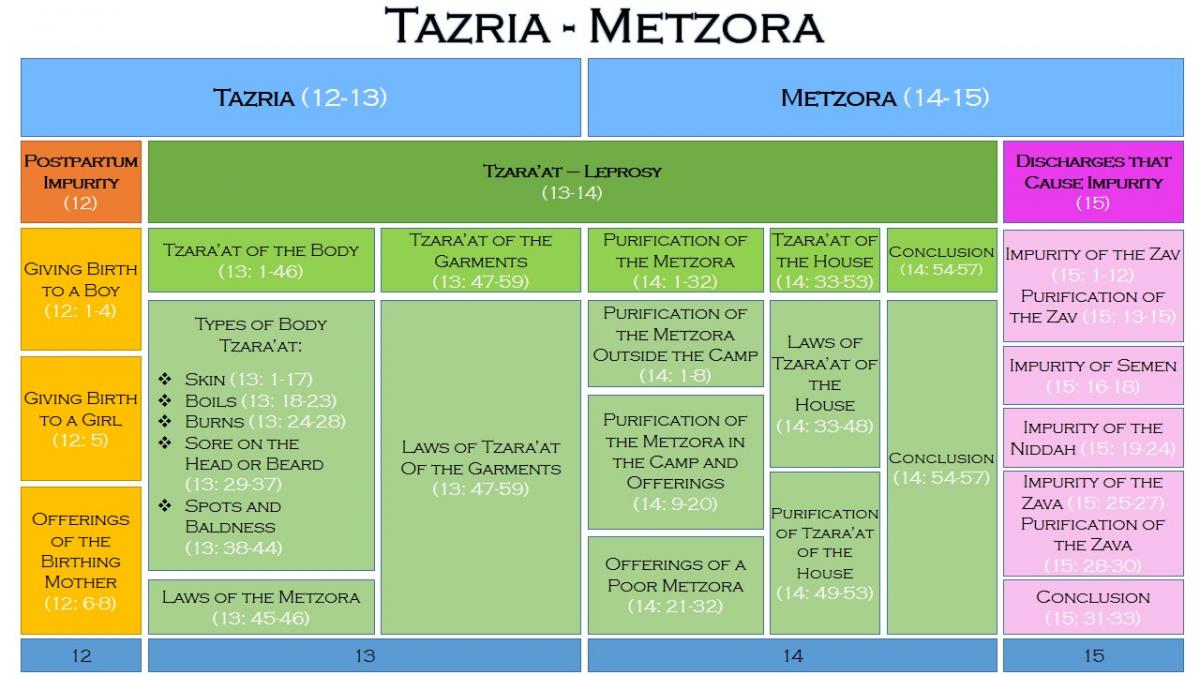
Structure of Tazria- Metzora

Volver al capítulo

תפילת נחשון

"הוֹשִׁיעֵנִי אֱלֹהִים כִּי בָאוּ מַיִם עַד נָפֶשׁ. טָבַעְתִּי בִּיוֵן מְצוּלָה וְאֵין מָעֳמָד בָּאתִי בְמַעֲמַקֵּי מַיִם וְשִׁבֹּלֶת שְׁטָפָתְנִי... הַצִּילֵנִי מִטִּיט וְאַל אֶטְבָּעָה אִנָּצְלָה מִשֹּׂנְאַי וּמִמַּעֲמַקֵּי מָיִם. אַל תִּשְׁטְפֵנִי שִׁבֹּלֶת מַיִם וְאַל תִּבְלָעֵנִי מְצוּלָה וְאַל תֶּאְטַר עָלַי בְּאֵר פִּיהָ" (תהילים ס"ט, ב-ג, טו-טז)


תלמוד בבלי מסכת סוטה דף לז עמוד א 

אמר לו רבי יהודה: לא כך היה מעשה, אלא זה אומר אין אני יורד תחילה לים, וזה אומר אין אני יורד תחילה לים, קפץ נחשון בן עמינדב וירד לים תחילה, שנאמר (הושע י"ב, א): "סבבוני בכחש אפרים ובמרמה בית ישראל ויהודה עוד רד עם אל". ועליו מפרש בקבלה (תהלים ס"ט): "הושיעני אלהים כי באו מים עד נפש, טבעתי ביון מצולה ואין מעמד... אל תשטפני שבולת מים ואל תבלעני מצולה וגו'". 

באותה שעה היה משה מאריך בתפלה, אמר לו הקדוש ברוך הוא: ידידיי טובעים בים ואתה מאריך בתפלה לפני? אמר לפניו: רבונו של עולם, ומה בידי לעשות? אמר לו (שמות י"ד): "דבר אל בני ישראל ויסעו", "ואתה הרם את מטך ונטה את ידך וגו'".


Volver al capítulo

Pages

x

Lee el Tanaj cómodamente. ¡Instala nuestra App en tu pantalla de inicio!

📲 Instala nuestra App

Toca el botón de Compartir (el icono de un cuadrado con una flecha hacia arriba) en la barra de Safari, desliza hacia abajo y selecciona 'Agregar a la pantalla de inicio'.