

The Ten Commandments
Found 25 Search results
The Ten Dibrot
Prof. Jonathan GrossmanWhat are the differences between the Ten Commandments in Yitro and the Ten Commandments in Va'ethanan? This lesson focuses on the differences in the mitzva of Shabbat, while noting the dual nature of Shabbat as a commemoration of the creation and a commemoration of the Exodus.
The Ten Commandments
Rabbi Yehuda RockThe Torah refers to the 'ten' commandments on the two stone tablets - but the division and identification is not explicit. This lesson will offer three divisions based on the Mesorah, and a fourth suggestion for dividing the commandments into ten.
The Oral Law and the Two Versions of the Ten Commandments (Audio)
Rabbi Yitzchak Blau | 10 minutesThe Ten Commandments in Devarim are slightly different from their presentation in Shemot. Which version was given out loud, and which appeared on the tablets? Different approaches are examined, each with fascinating ideas pertaining to revelation, prophecy, and the connection between the written and the Oral Law.
The Ten Dibrot (audio)
Prof. Jonathan Grossman | 13 minutesThis shiur compares the Ten Commandments as they appear in Devarim with their form in Sefer Shemot. Most significantly, there appears to be an entirely different explanation for the commandment of Shabbat. Is Moshe in his "repetition" deviating from the original commandments from the Revelation at Sinai? Why is he quoting from parashat Mishpatim instead of from parashat Yitro? What is the purpose of the disparity between Shemot and Devarim?
Sefer Devarim, the Most ‘Misunderstood’ Book of the Bible
Rabbi Menachem Leibtagתאריך פרסום: תשסט | |
What is the purpose of Sefer Devarim? Rabbi Menachem Leibtag challenges the popular assumption that Sefer Devarim is a ‘review’ of the rest of Chumash, and proves that, in fact, Sefer Devarim is a crucial ending to the Chumash. By examining the progression from Sefer Shmot all the way to Devarim, we can see that Devarim is not a historical review; rather it details how Am Yisrael must become a nation representing God, utilizing a whole new set of laws, once they enter the land of Israel.
Shavuot
Rabbi Ezra Bick | 14 minutesAccording to our tradition, the Torah was given on the 6th of Sivan, the day on which we observe the holiday of Shavuot, but only received by Am Yisrael on the 7th of Sivan. By celebrating Shavuot on the day of the giving of the Torah rather than on the day of its reception (which we essentially celebrate every day when we learn Torah) we reconnect our Torah with the voice of God.
How to Divide the Ten Commandments
Rabbi Alex IsraelThe Ten Commandments are maybe the best-known of all Jewish laws. They are perceived widely as a universal code of ethics. Within Judaism, they are one of the most prominent symbols of the faith. This article investigates certain aspects of this group of laws, namely, their unusual format and their unique message of the two different ways of approaching God.
Study Questions for Tikun Leil Shavuot
Rabbi Menachem LeibtagOn Shavuot night, the study of Torah takes on an added dimension, as we mark the anniversary of Matan Torah. This includes not only the minhag of learning throughout the night, but also HOW we learn. In other words, our learning should be more ACTIVE than passive. Towards this end, I have opted this week to write questions for self study, as opposed to a regular ('spoon fed') shiur in the hope that they will facilitate a more active manner of learning.
So, in case you are looking for a 'structured' learning program for Shavuot night, with or without a chavruta, I am sending out some 'preparation questions' which deal with Shavuot and Matan Torah.
Study Questions on the Ten Commandments
On Shavuot we commemorate Matan Torah and our receiving of the Ten Commandments. While most of us have a general idea as to the composition of this famous Decalogue, Tikun Leil Shavuot is a great opportunity to explore, in a little more depth, what each of these commandments entails. Are there really ten? How might the commandments be divided? Are there any discrepancies between the listing of the commandments in Shmot vs. in Dvarim? Below are some guiding questions to help you get started. For more in-depth study, please see these articles on the topic of the Ten Commandments.
Remembering Sinai (Audio)
Rabbi Yair Kahn | 13 minutesThe threefold repetition of Ma’amad Har Sinai in Moshe’s speech stresses the centrality and complexity of that event. One central message is that Moshe is the facilitator in the transfer of the Torah to the nation. Both the Ramban and the Kuzari place Ma’amad Har Sinai as a central theological pillar.
Remembrance of the Revelation at Mount Sinai in Moshe's Speech
Rabbi Dr. Tamir GranotAccording to Moshe's speech in Parshat Va'etchanan, the primary significance of Ma'amad Har Sinai is God's direct revelation to Israel. However, the description of Ma'amad Har Sinai in Sefer Shemot focuses on Israel's belief in Moshe as a true prophet. By closely examining the two instances of revelation, one can see that the purpose of the speech in Devarim was to establish the faith for all generations even when individuals and the community as a whole do not experience a revelation as had occurred during the exodus from Egypt or at Mount Sinai. From here it follows that faith in the book of Devarim rests on the foundations of prophecy, memory, and story, and not on unmediated experience.
Inseparable Pair
Rabbi Ben-Tzion SpitzThe Casuistic Unit in Parshat Mishpatim
Rabbi Meir Lichtenstein | Hour and 7 minutesParshat Mishpatim is comprised of casuistic laws – cases which are described as though they have already occurred and laws presented accordingly. When closely examining these laws, one can notice that there is a direct link between these laws and actual occurrences in Sefer Bereishit. Through a close comparison of Shemot and Bereishit, we learn about the relationship between our moral compass and legal discourse and how it sheds light on the stories of Bereishit and our own lives.
Remembering Shabbat- Commentary and Halacha
Dr. Baruch Alster | Hour and 4 minutesThe mitzva of Shabbat is portrayed in both the ten commandments listed in sefer Shemot and in sefer Devarim- with a slight difference in wording. The medieval commentaries attempt to resolve this difference through a variety of explanations which shape their opinions of the very nature and essence of Shabbat. Through a discussion of these various opinions we learn about the proper method of interpreting not only the mitzva of Shabbat but also the rest of the Torah itself.
The Tenth Commandment: "You Shall Not Covet"
Rabbi Elchanan SametWhat is the reason for the prohibition "You shall not covet ... nor shall you desire..." that comes to limit man's thoughts and feelings even when they do not find external, practical expression? This article explores some prevalent interpretations that attempt to answer this question, focusing on the danger to the coveter himself rather than to those around him.
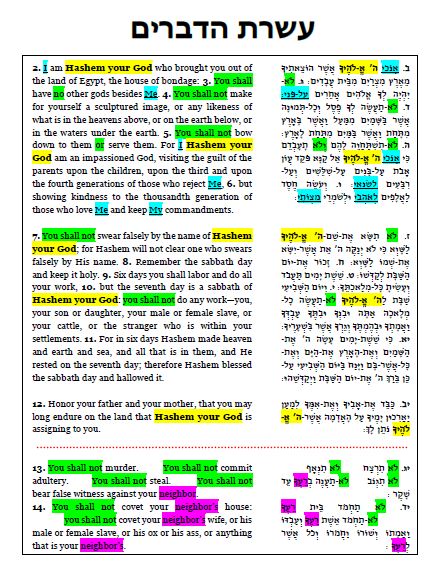
Ten Commandments Study Guide
HaTanakh.com StaffUse the text below to answer the following questions. You can find a printable PDF version of the text attached.
1. Take a look at the blue highlighted words which are found in the first two commandments (verses 2-6). What is the difference between these commandments and the rest?
Look at Exodus 20:15 and Rashi’s commentary on Exodus 19:19. How can these sources help us understand this difference?
2. Count the number of commandments that you find in the text. Are there really only 10? Where does the traditional phrase of “Ten Commandments” come from?
Look at Deuteronomy 4:13. How might we more accurately describe the “Ten Commandments” according to this verse? How is the phrase עשרת הדברים translated? Does it necessarily have to mean “commandments”?
We can conclude that there are ten STATEMENTS, and each could contain within it more than one commandment.
[The Sefer HaChinuch enumerates 15 separate commandments, 25-38; 416]
Take a look at the green highlighted words. How many negative commandments can you count? How are they divided between both tablets? (the red dotted line marks the separation between the two tablets)
3. One of the most popular opinions regarding the division of the commandments holds that the first tablet contains the commandments between man and God, while the second tablet contains the commandments between man and fellow man. Look at the yellow and purple highlighted words. What can we infer about the theme of each tablet? Does it support this claim?
Structure and Meaning in the Ten Commandments
Rabbi Alex Israel | Hour and 11 minutesHow many commandments are included in the Aseret Hadibrot? How can they be divided? An analysis of the structure of the Ten Commandments, as well as its comparison with Ancient Near East treaties allows us to gain deeper insights into the messages of the Ten Commandments and the meaning of a personal connection with God.
One is Holy
Rabbi Jay KelmanShavuot: Learning to Say No
Rabbi Elyakim KrumbeinWhen studying the Biblical text, one common tool used to uncover the intention of the verses is locating the “keyword” for a particular section. Can we identify a keyword for the Ten Commandments that stand at the heart of the Sinaitic covenant? It seems to me that the most striking candidate is the Hebrew word “Lo,” “You shall not.”
The message behind all these negative commandments – in the Torah in general and in the Ten Commandments in particular – may be found in the last Commandment, the strange prohibition of “You shall not covet,” which is so different from all the other nine Commandments. Why was this one included?
The Torah wishes to reveal its general understanding of the idea of “Lo,” “You shall not” or “No.” In addition to teaching us to accept authority, it expects us to try to emulate our Maker, and learn to say “No.”
"Examine it Through and Through - For All is Contained Therein"
Rabbi Jonathan MishkinWhat is so special about the Aseret Ha-dibrot? Why have they captured the imagination of generations of Jews who insist on their transcendent nature? Are the thirteen verses in question holier than other parts of the Torah?
The Ten Commandments: Twelve Prohibitions
Rabbi Dr. Yoel Bin NunHow many prohibitions are there in the Ten Commandments? Most people mistakenly believe that there are seven prohibitions. We explore the idea that there are six prohibitions in the first and second tablets, making up twelve. We explore the significance of the "six" and "twelve" numerical structures here and elsewhere in the Torah, and examine the differences between the first and second Tablets.
The Expanded Shema
Rabbi Dr. Yoel Bin NunKeriat Shema, the twice-daily creed, is a focal point of our prayers, with its first two paragraphs, Shema and Ve-haya im Shamoa, coming from Sefer Devarim: 6:4-9 and 11:13-21 respectively. These two passages share thematic elements and details. In addition, they bookend the “commandments of faith."
These similarities are readily apparent if we read the expanded text of Shema (Devarim 6) along with the expanded text of Ve-haya im Shamoa (10:12–11:25).
The correspondence between the two units is clearly apparent. We delve into what comes in between, and we consider the clear connections between these two units and the opening statement of the Ten Commandments.
Va'etchanan: Seeing Layers in the Ten Commandments
Rabbi David Fohrman |We've seen the text of the Ten Commandments so many times, but how does the Torah pack so much meaning into so few words? In this parsha video, Rabbi Fohrman shows us how the Torah layers meaning into the Ten Commandments, giving us a sample of the subtleties of the Torah.
If you enjoyed this video, please visit AlephBeta.org to watch more.וַיְדַבֵּ֣ר אֱלֹהִ֔ים אֵ֛ת כָּל־הַדְּבָרִ֥ים הָאֵ֖לֶּה לֵאמֹֽר׃ (ס)
Exodus 20, verse 1
אָֽנֹכִי֙ יְהוָ֣ה אֱלֹהֶ֔יךָ אֲשֶׁ֧ר הוֹצֵאתִ֛יךָ מֵאֶ֥רֶץ מִצְרַ֖יִם מִבֵּ֣֥ית עֲבָדִֽ֑ים׃
Deuteronomy 5, verse 6